Showing posts with label open source. Show all posts

Wednesday, 19 April 2023


Andrea Valenzuela

Apr 4

8 min read

Improve ChatGPT Performance with Prompt Engineering

Image by Brett Jordan inUnsplash

ChatGPT generates responses using a technique called autoregression, which involves predicting the most likely next word in a sequence based on the previous words. But, if you try ChatGPT, you will soon realize that the quality of a given answer also depends on the quality of the question.

The secret for getting back the best possible answer is to understand how ChatGPT will generate it, and formulate the question accordingly.

In this article, we will discuss a few tricks to write good ChatGPT prompts so that you can maximize its outcome for your desired task.

⚠️ Terminology Recap: The technical name for a question is prompt, and putting some thoughts on the question we ask to maximize ChatGPT’s outcome is known as prompt engineering.

Ciphers Lab is a USA-based Digital Product Studio, that provides services like Web App design & development, Mobile Application design & development, UI/UX, Chatbot development, E-commerce development, Designing & Branding, Social Media Marketing, and virtual CTO. For further information. get connected now 

Model Capabilities Depend on the Context

When starting with ChatGPT, one common mistake is to believe that its capabilities are fixed across all contexts.

For example, if ChatGPT is capable of successfully answer a concrete question or do a certain task, we may think it might be capable of answering also a question in any domain, or to solve other types of tasks.

But that is not true :(

📚 ChatGPT has been trained on a huge but yet limited database, and it has been optimized for certain tasks.

Nevertheless, using the right prompts can help ChatGPT to find the correct answer in a concrete unseen domain or to master a new task.

Model Capabilities Also Depend on the Timing

It can also happen that ChatGPT gives wrong answers when solving complex tasks.

As in humans, if you give a person a sum of 4 digits, they will need some time for thinking and answering back with the correct answer. If they do it in a hurry, they could easily miscalculate. Similarly, if you give ChatGPT a task that’s too complex to do in the time it takes to calculate its next token, it may confabulate an incorrect guess.

🧠 Yet, akin to humans, that doesn’t necessarily mean the model is incapable of the task. With some time to reason things out, the model still may be able to answer reliably.

There are ways to guide ChatGPT to succeed in solving your complex tasks.

And now it is time! Let’s explore those techniques!

Zero-shot prompting

People use zero-shot promping most of the time when using ChatGPT. We call it zero-shot when the person asks a question straight away.

In those cases, and if the question is simple enough, the model will be able to provide a coherent response. But with this method the user cannot control the accuracy of the response or the format.

Here are a few examples of zero-shot prompting in ChatGPT:

Self-made image. Screenshot from ChatGPT web interface.

In these examples, the prompt consists of a simple question or statement, and ChatGPT provides the correct answer even without any prior training on the specific task or topic.

🙌🏼 This demonstrates the power of zero-shot prompting and the ability of large language models like ChatGPT to generate human-like answers and eventually generalize to new tasks and domains.

Improve your Zero-Shot

There are a few tricks to write good prompts while using zero-shot promping, such as giving clearer instructions or splitting complex tasks into simpler subtasks. Nevertheless, this tricks can be a bit void without concrete examples or knowing the theory behind.

There is a good standard sentence to include in your prompts no matter which complex task are you asking ChatGPT to solve:

Let's think step by step

The “Let’s Think” trick

Published by Takeshi Kojima et al. in 2022, the easiest way to prompt a model to reason out the answer is to simply prepend answers with Let's think step by step.

This simple statement can help the model steer itself toward the correct output. Since it will prompt the reasoning step by step, it is also a way to give the model the required timing to generate the correct answer.

The Let's think step by step trick works well on complex tasks such as math problems or questions requiring some reasoning, but also in general questions:

Self-made image. Screenshot from ChatGPT web interface.

As we can see, ChatGPT only provides the most updated answer when using the Let's think step by step statement.

💭 If you apply this technique to your own tasks, don’t be afraid to experiment with customizing the instruction! Let's think step by step is rather generic, so you may find better performance with instructions that how to a stricter format customized to your use case.

For example, you can try more structured variants like First, think step by step about why X might be true. Second, think step by step about why Y might be true. Third, think step by step about whether X or Y makes more sense which can also give notable improvements.

This techinique is basically forcing the model to gradually reason out the answer!

Impressed by the Let’s think step by step? Find out more about it at:

Use This Short Prompt to Boost ChatGPT’s Outcome

Get the Most Out of ChatGPT “Step by Step”

medium.com


Ciphers Lab is a USA-based Digital Product Studio, that provides services like Web App design & development, Mobile Application design & development, UI/UX, Chatbot development, E-commerce development, Designing & Branding, Social Media Marketing, and virtual CTO. For further information. get connected now 

One-shot prompting

In some cases, it’s easier to show the model what you want rather than tell the model what you want. This is specially useful if you need an answer on an specific format or with certain accuracy.

While zero-shot learning in ChatGPT enables the model to generate responses to new tasks without any explicit training, one-shot prompting involves showing to the model a small set of examples that are similar to the target task, allowing it to quickly adapt and provide accurate responses.

🔫 This technique allows the generation of natural language text with a limited amount of input data, such as a single example or template and it can allow for the creation of predictable outputs.

For example, if a company wanted to create a chatbot to assist with customer support, they might use one-shot prompting to fine-tune the ChatGPT model on a small set of customer inquiries and responses.

As mentioned above, one-shot prompting is specially useful if you need a certain output format:
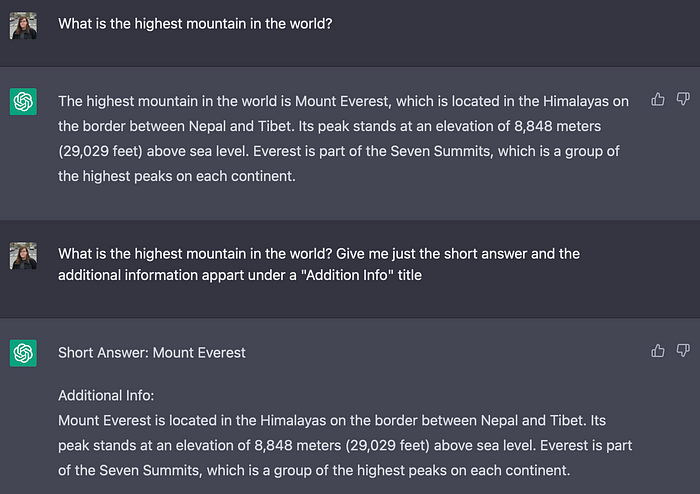
Self-made image. Screenshot from ChatGPT web interface.

As we can see from the example above, ChatGPT adapts its output to the desired format.

Few-shot prompting

While zero-shot tricks and one-shot prompting are powerful tools already, few-shot prompting takes the concept a step further by allowing the model to quickly learn new tasks with a higher amount of data.

Few-shot prompting was studied by studied by Jason Wei and Denny Zhou et al. from Google and it can be seen as demonstrating the model how to answer with a few examples.

📊 Few-shot learning works the same as one-shot, but the number of examples given is higher, typically around a hundred. The performance of the model increases linearly with the numer of examples.

This approach is particularly useful for tasks that require more specialized or domain-specific knowledge, where the model may not have sufficient background knowledge to perform the task using zero-shot or one-shot prompting.

For example, imagine a company wants to develop a chatbot to assist with medical diagnoses. While one-shot prompting may be effective for training the model on a few common medical conditions, it may not be sufficient for more complex diagnoses. In this case, few-shot learning could be used to fine-tune the model on a small set of medical cases and diagnoses, allowing the chatbot to provide accurate and informed medical advice.

In this case, you could include the following information in your prompt:

Prompt: Q: What are the symptoms of the flu?
A: The flu is a respiratory illness caused by the influenza virus. Common symptoms 
include fever, cough, sore throat, runny or stuffy nose, body aches, headache, chills, and 
fatigue.

Q: What are the symptoms of a heart attack?
A: A heart attack occurs when blood flow to the heart muscle is blocked. Common 
          symptoms include chest pain or discomfort, shortness of breath, lightheadedness, 
          nausea, and pain or discomfort in the arms, back, neck, jaw or stomach.

Q: What are the symptoms of a stroke?
A: A stroke occurs when blood flow to the brain is disrupted. Common symptoms 
           include sudden weakness or numbness in the face, arm, or leg (especially on one 
           side of the body), confusion, trouble speaking or understanding speech, vision 
           problems, dizziness, and severe headache.

With this prompt, the chatbot can use the provided Q&A pairs as context to help diagnose medical conditions. When prompted with a symptom such as “I have a fever and a cough”, the chatbot can leverage its understanding of symptoms from the provided Q&A pairs to generate a more informed response.

Ciphers Lab is a USA-based Digital Product Studio, that provides services like Web App design & development, Mobile Application design & development, UI/UX, Chatbot development, E-commerce development, Designing & Branding, Social Media Marketing, and virtual CTO. For further information. get connected now  

Advantages of Few-Shot prompting

One advantage of the few-shot example-based approach relative to the Let's think step by step technique is that you can more easily specify the format, length, and style of reasoning that you want the model to perform.

This can be be particularly helpful in cases where the model is not initially reasoning in the right way or depth.

💪🏼 Finally, if few-shot prompting is not enough for your concrete task, you can also try really fine-tunning your own ChatGPT by applying transfer learning with your desired data. Check out the following article to fine-tune ChatGPT with Python:

And that is it! Prompt engineering techniques such as zero-shot, one-shot and few-shot prompting can give you more flexibility and control when creating outputs by taking advantage of the power of models like ChatGPT.

Consider trying the techniques in this article to build more reliable, high-performing prompts, now that you know how prompt engineering can impact your outputs!

And one more fact before you go!

Maximizing ChatGPT outcomes has become so popular that we have started seeing a lot of job offerts about Promp Engineering seeking for someone knowing how to get the desired knowledge from ChatGPT.

Let me know in the comments if you want me to write about more techniques to improve reliability of the language models!

Ciphers Lab is a USA-based Digital Product Studio, that provides services like Web App design & development, Mobile Application design & development, UI/UX, Chatbot development, E-commerce development, Designing & Branding, Social Media Marketing, and virtual CTO. For further information. get connected now 


How to Enhance ChatGPT with Prompt Engineering

In November 2022, OpenAI used its GPT-3.5 language models to launch ChatGPT. Leading experts from around the world are taking notice of this astounding tool, which, less than a month after its introduction, already has more than one million users. On the internet, there are countless screenshots and user testimonials demonstrating how useful ChatGPT has been for everyone from professionals to university students, bloggers, and influencers. 

ChatGPT is a powerful large language model (LLM) that can generate text in response to a wide variety of prompts. These models continue to generate better results over time, but it can be challenging to get exactly the result you want. To get the most out of ChatGPT, it is important to carefully consider the prompts you use when interacting with the model.  

Improving your prompt engineering skills is the most efficient way to take advantage of the possibilities of these massive models. High-quality prompts can direct ChatGPT toward particular tasks or subjects and enhance the relevance and coherence of the model’s responses. 

Ciphers Lab is a USA-based Digital Product Studio, that provides services like Web App design & development, Mobile Application design & development, UI/UX, Chatbot development, E-commerce development, Designing & Branding, Social Media Marketing, and virtual CTO. For further information. get connected now

What is Prompt Engineering?

Prompt engineering is the process of crafting high-quality prompts to interact with a language model. The goal of prompt engineering is to provide the language model with the necessary context and information to generate relevant and coherent text in response to the given prompt. 

The process of prompt engineering involves carefully considering the language, structure, and content of the prompt, in order to guide the language model towards the desired outcome. This means providing specific instructions, asking targeted questions, or providing additional context that the LLM can use to generate text that is tailored to the task at hand. 

When utilizing language models for tasks like writing, translating, or chatbots, where the quality of the output is greatly influenced by the quality of the input prompt, effective prompt engineering can be critical. The accuracy, relevance, and coherence of the language model’s output, as well as the user experience, can be enhanced by developing high-quality prompts that are designed to elicit the desired response. 

Ciphers Lab is a USA-based Digital Product Studio, that provides services like Web App design & development, Mobile Application design & development, UI/UX, Chatbot development, E-commerce development, Designing & Branding, Social Media Marketing, and virtual CTO. For further information. get connected now 

Tips for Enhancing ChatGPT

  1. Start with a clear objective: Using the prompt, decide what you want the chatbot to accomplish. This could be providing information, directing the conversation, or addressing an issue. If your inquiry is vague, your answer will be ambiguous. Instead of asking a general question like “What is the weather like today?”, try asking a more specific question like “What is the temperature in New York City right now?” 
  2. Provide context: Large language models perform best when they  have enough context to understand the task or topic at hand. When crafting a prompt, try to provide as much relevant context as possible. This could include things like previous messages in a chat, links to articles or other resources, or a summary of the topic you want to discuss. 
  3. Use natural language: ChatGPT is designed to understand natural language, so try to phrase your prompts in a way that feels conversational. Avoid using overly technical language or jargon that the model may not be familiar with. 
  4. Experiment with different styles: ChatGPT can generate text in a wide variety of styles, from formal to conversational, humorous to serious. Try experimenting with different styles of prompts to see how the model responds. A conversational prompt might result in a more casual and comfortable response, whereas a formal prompt might produce one that is more structured and precise. You may find that certain styles work better for certain tasks or topics. 
  5. Avoid open-ended questions: Do not pose questions with ambiguous or open-ended answers. This may cause the chatbot to respond in a way that is irrelevant or unclear. Here is an example of a vague prompt, versus an engineered prompt:  

A prompt such as “Where should I go for dinner?” is too ambiguous and the model cannot give a useful recommendation without more context. 


A specific prompt such as “Can you recommend an affordable Cuban restaurant open tonight in Downtown Miami with great reviews?” has much more detail and enables the model to recommend a restaurant with an address, phone number, and highlights from the menu. 

 Ciphers Lab is a USA-based Digital Product Studio, that provides services like Web App design & development, Mobile Application design & development, UI/UX, Chatbot development, E-commerce development, Designing & Branding, Social Media Marketing, and virtual CTO. For further information. get connected now


It is important to note that no technology, especially at this scale, comes without risks and challenges. In many ways, LLMs are a game-changer, and this incredible technology is now being widely used without many limitations or controls. There are several potential pitfalls, including bias and inaccuracy. 

Prompt engineering is a powerful tool for getting the most out of large language models such as ChatGPT. By carefully crafting your prompts, you can improve the relevance and coherence of ChatGPT’s responses and guide the model towards specific tasks or topics. With some experimentation and practice, you can become an expert at using prompt engineering to tap into the staggering capabilities of large language models. 

Tuesday, 21 March 2023

Artificial intelligence: 3 trends to watch in 2023


As AI tools increasingly find their way into mainstream business applications, here are three key trends to watch in the coming year
Register or Login to like
CIO_AI_intelligence_idea

The artificial intelligence (AI) market has been on a swift growth path for several years – so much so that the industry is expected to reach $42.4 billion in 2023. This momentum will continue, and we’re starting to realize it with the debut of powerful new AI-powered tools and services across industries.

There has been a shift from the well-understood role of AI in analysis and prediction – helping data scientists and enterprises make sense of the world and chart their courses accordingly – to new and innovative systems, like DALL-E, that are producing entirely new artifacts that have never been seen before.

But what’s driving this exponential growth, and how will it affect the space in the coming year? Here are three key AI trends that will take shape in 2023:

We have an experienced team at Ciphers Lab that can help you in setting a stunning web application that will boost your sales online. get connected now

1. AI democratization will continue

AI is becoming a fundamental differentiator for business. If you can’t find deeper insights in data, quickly and at scale, your competitors will. There is far less supply than demand, and top engineering and data science talent will remain extremely expensive. As a result, more AI consultants and greater availability of low- and no-code features will become differentiators. This democratization of AI will help simplify the adoption of these technologies in all vertical markets by those with varying levels of experience.

[ Also read Responsible AI by design: Building a framework of trust. ]

Additionally, cloud vendors will increasingly combine their services building blocks to include AI, leading to powerful, widely available features and solutions. This is important for two reasons:

  • Whether they know it or not, more people will be using AI than ever, putting it in the hands of the masses.
  • We’re starting to realize the bottom-line business drivers of AI, which will trickle down from the aforementioned major cloud vendors to smaller tech players, leading to even greater AI adoption.

2. Generative AI will become commercialized

Generative AI is having a moment, and we’ll start to see many more products and services come to market in 2023. This area is exciting because many largely untapped but valuable use cases exist.

One particularly bright spot is generative AI-powered language applications. In gaming, for example, a user can opt to sound like their on-screen character. In a virtual meeting, a person with a cold can make their voice easier to understand, enabling them to focus on their work contributions rather than potential misunderstandings.

Unlike AI-generated imagery, which has recently gained a lot of attention, business use cases are lacking. Speech-to-speech (S2S) technology, on the other hand, has the potential to change the way we work. For customer service, this can be a game-changer. For example, contact center agents can use generative AI to clearly understand callers from anywhere in the world, helping them resolve problems faster and feel more empowered.

3. AI ethics will become a top priority

Despite its proven value and great potential, AI still has complex legal and ethical issues. The severity varies – new implications can range from negative to dangerous. From deep fakes to biased algorithms to models that have degraded over time, these are all scary reminders that regulatory frameworks must adapt to the fast-evolving AI market. And while regulatory and legal frameworks are currently in the works, with an AI Bill of Rights in the near future, businesses must approach AI safely and ethically.

The first class-action lawsuit in the US against an AI system was recently filed, and it won’t be the last. Technology may be leaps ahead of the legal industry, but as AI embeds itself into our everyday lives, companies and governments must get serious about safe and responsible practices. We will also see more transparency around cases like this and learn how to avoid these missteps for future deployments.

[ Learn the non-negotiable skills, technologies, and processes CIOs are leaning on to build resilience and agility in this HBR Analytic Services report: Pillars of resilient digital transformation: How CIOs are driving organizational agility. ]

We have an experienced team at Ciphers Lab that can help you in setting a stunning web application that will boost your sales online. get connected now

Although we’ve been saying it for a decade, 2023 will be another high-growth year for AI. The commercialization of new products and features, strides in access and affordability, and a focus on responsible practices will open up disruptive use cases for the enterprise and beyond.

It’s an exciting time to be in the AI space, and it will be interesting to see how the industry progresses over the next 12 months.

We have an experienced team at Ciphers Lab that can help you in setting a stunning web application that will boost your sales online. get connected now

Chat GPT-4 – All You Need To Know

  • Last Updated : 19 Mar, 2023
  1. Read         2. Discuss

Open AI’s ChatGPT has been the talk of the town for quite a time now. And with the new update of GPT-4 released on 14th March 2023, the words about this remarkable AI chatbot have surfed again!  

But what are the new updates and all the fuss about? If you also have such intriguing questions on your mind, this blog is for you! 

What is Chat GPT-4?


In this blog, we’ll talk about the new updates, features, expands, and everything related to the upcoming Chat GPT 4 chatbot. But before all that, let’s first understand what Chat GPT is!

We have an experienced team at Ciphers Lab that can help you in setting a stunning web application that will boost your sales online. get connected now

Related Article – Difference Between ChatGPT and Google

What is GPT-4?

Simply saying, GPT-4 is a smart combination of artificial intelligence, natural language processing, and machine learning. It is an AI-supported chatbot that helps users to generate content. 

GPT-4 is the perfect solution for businesses or customers who want an efficient, personalized experience when engaging with customer service agents. This powerful AI-driven system enables users to have natural conversations that feel just like interacting with a human customer service representative.

GPT-4 makes communicating effortless and intuitive with its user-friendly design. Through this AI-driven system, users can enjoy natural conversations that feel just like interacting with an actual human being.

What’s more – GPT-4` offers companies powerful tools such as:

  • Automated dialogue and scenario management capabilities
  • Automatic response creation and generation

Thanks to its ease of use, increased accuracy of communication, and customer-facing benefits, this AI-supported Chatbot has become increasingly popular among businesses of all sizes.  

What’s new in this version of GPT-4?

Be it creativity, collaborative prowess, editing, iteration, or technical writing, ChatGPT 4 is a +1 in every term from the previous versions. 

“We spent 6 months making GPT-4 safer and more aligned. GPT-4 is 82% less likely to respond to requests for disallowed content and 40% more likely to produce factual responses than GPT-3.5 on our internal evaluations.”, quoted by OpenAI.

OpenAi also revealed that ChatGPT-4 outperformed the previous versions in some tests by scoring way higher. 
 

The ChatGPT 4 chatbot will allow users to interact with AI more effectively and efficiently. Moreover, users will have ease of producing content of their own style as ChatGPT can recognize and understand users’ writing styles. 

ChatGPT 4 uses natural language processing techniques to provide results with the utmost accuracy. Therefore, it is far more reliable in terms of producing legitimate results in time.

The AI-driven system is highly advanced and sophisticated, but also intuitive enough for users to get a feel for how the technology works within minutes. With this powerful system, businesses can create personalized conversations that feel just like talking to an actual human representative – no matter where they are in the world!

We have an experienced team at Ciphers Lab that can help you in setting a stunning web application that will boost your sales online. get connected now

1. Image Recognization

A major feature of the new ChatGPT 4 is image recognition. Earlier versions of ChatGPT are only efficient in recognizing and understanding the text,  but with the new version, users will be able to generate content through images too.  

2. Pricing

Another significant difference between ChatGPT 4 and the previous OpenAI ChatGPT is the subscription price. The current subscription for Chat GPT 4 is $20/month in India and USA. ChatGPT 4 is much higher in cost than the previous versions of ChatGPT. AI experts also suggest that one should try their hands on ChatGPT first before they try ChatGPT 4.

3. Multilingual Capabilities

As compared to the previous ChatGPT version, ChatGPT 4 holds tremendous multilingual capabilities. As per reports, ChatGPT can answer MSQs of around 26 languages. 

4. Steerablity

A new feature that wasn’t available in the previous versions is Steerability. ChatGPT 4 Steerability allows users to customize the AI’s behavior. Therefore, now you can make the AI chatbot understand your commands more precisely. 

Conclusion

As the world is slowly turning towards artificial intelligence, the ask or demand for quality AI content generators is increasing. For sure, OpenAi’s ChatGPT has proved to be a great AI asset for content creators and artists. However, it will not be wrong to say that there are still a lot of improvements needed. 

The potential applications of ChatGPT-4 are immense and it’s already grabbing the attention of tech enthusiasts and business leaders alike. The lives of many could be made easier thanks to this intelligent AI system which has the capacity to simulate human conversation unmatched by any other chatbot available today. 

We have an experienced team at Ciphers Lab that can help you in setting a stunning web application that will boost your sales online. get connected now

Monday, 20 March 2023

What is ChatGPT and why does it matter? Here's everything you need to know

What is ChatGPT and why does it matter? Here's everything you need to know

Updated: This AI chatbot's advanced conversational capabilities have created quite the buzz. Here's what you need to know.


ChatGPT is a natural language processing tool driven by AI technology that allows you to have human-like conversations and much more with a chatbot. The language model can answer questions, and assist you with tasks such as composing emails, essays, and code.

Also: How does ChatGPT work?

Usage is currently open to public free of charge because ChatGPT is in its research and feedback-collection phase. As of Feb. 1, there is also a paid subscription version called ChatGPT Plus.

ChatGPT was created by OpenAI, an AI and research company. The company launched ChatGPT on Nov. 30, 2022. 

Also: What is GPT-4? Here's everything you need to know

OpenAI is also responsible for creating DALLE•2, a popular AI art generator, and Whisper, an automatic speech recognition system. 


We have an experienced team at Ciphers Lab that can help you in setting a stunning web application that will boost your sales online. get connected now


How big a deal is ChatGPT?

It's certainly made a big splash. "ChatGPT is scary good. We are not far from dangerously strong AI," said Elon Musk, who was one of the founders of OpenAI before leaving. Sam Altman, OpenAI's chief, said on Twitter that ChatGPT had more than 1 million users in its first five days after launching. Altman told Musk the average cost of each response was in "single-digits cents" but admitted it will need to monetize it eventually because of its "eye-watering" compute costs. 

According to analysis by Swiss bank UBS, ChatGPT is the fastest growing app of all time. In January, only two months after its launch, UBS analysis estimates that ChatGPT had 100 million active users. For comparison, it took nine months for TikTok to reach 100 million. 

For full story read: ChatGPT just became the fastest-growing 'app' of all time

You can access ChatGPT simply by visiting chat.openai.com and creating an OpenAI account. 

Once you sign in, you are able to start chatting away with ChatGPT. Get your conversation started by asking a question. Because ChatGPT is still in its research stage, it is free to use and you can ask as many questions as you'd like.

For step-by-step instructions, check out ZDNET's guide about how to start using ChatGPT.


We have an experienced team at Ciphers Lab that can help you in setting a stunning web application that will boost your sales online. get connected now 

ChatGPT is free to use at the moment because it is still in its research phase. Because of the stir its advanced capabilities have made, a lot of people are flocking to use it. The website operates using a server, and when too many people hop onto the server, it overloads and can't process your request. This doesn't mean you won't ever be able to access it. It just means you should try visiting the site at a later time when fewer people are trying to access it. You can also keep the tab open and just refresh it periodically. 

Also: OpenAI launches ChatGPT Plus, a new subscription service

If you want to skip the wait and have reliable access, there is an option for you. As of Feb. 1, OpenAI has a ChatGPT pro plan, ChatGPT Plus, which allows users to have general access even during peak times, experience faster response times and have priority access to new features and improvements. The premium services does come at a cost of $20/month. 


We have an experienced team at Ciphers Lab that can help you in setting a stunning web application that will boost your sales online. get connected now

The model has many functions in addition to answering simple questions, such as composing essays, describing art in great detail, creating AI art prompts, and having philosophical conversations, and it can even code for you. 

Also: ChatGPT productivity hacks: Five ways to use chatbots to make your life easier

My personal favorite is asking the chatbot for help creating basic lists such as packing, grocery and to-do lists to make my everyday more productive. The possibilities are endless.

ChatGPT runs on a language model architecture created by OpenAI called the Generative Pre-trained Transformer (GPT). The specific GPT used by ChatGPT is fine-tuned from a model in the GPT-3.5 series, according to OpenAI. Generative AI models of this type are trained on vast amounts of information from the internet including websites, books, news articles and more. 

Also: What is generative AI and why is it so popular? Here's everything you need to know

The language model was fine-tuned using supervised learning as well as reinforcement learning. The use of Reinforcement Learning from Human Feedback (RLHF) is what makes ChatGPT specially unique. Through RLHF, human AI trainers provided the model with conversations in which they played both parts, the user and AI assistants, according to OpenAI. 

ChatGPT is a language model created with the purpose of holding a conversation with the end user. A search engine indexes web pages on the internet to help the user find the information they asked for. ChatGPT does not have the ability to search the internet for information. It uses the information it learned from training data to generate a response, which leaves room for error. 

Also: ChatGPT or Google: Which gives the best answers?

Another major difference is that ChatGPT only has access to information up to 2021, whereas a regular search engine, such as Google, has access to the latest information. Therefore, if you ask ChatGPT who won the World Cup in 2022, it wouldn't be able to give a you response and Google would. 


We have an experienced team at Ciphers Lab that can help you in setting a stunning web application that will boost your sales online. get connected now

Despite looking very impressive, ChatGPT still has limitations. Such limitations include the inability to answer questions that are worded a specific way, as it requires rewording to understand the input question. A bigger limitation is a lack of quality in the responses it delivers -- which can sometimes be plausible-sounding but make no practical sense or can be excessively verbose. 

Also: These experts are racing to protect AI from hackers. Time is running out

Instead of asking for clarification on ambiguous questions, the model just takes a guess at what your question means, which can lead to unintended responses to questions. Already this has led developer question-and-answer site StackOverflow to at least temporarily ban ChatGPT-generated responses to questions.

"The primary problem is that while the answers that ChatGPT produces have a high rate of being incorrect, they typically look like they might be good and the answers are very easy to produce," says Stack Overflow moderators in a post. Critics argue that these tools are just very good at putting words into an order that makes sense from a statistical point of view, but they cannot understand the meaning or know whether the statements it makes are correct.

Also: OpenAI's ChatGPT is scary good at my job, but it can't replace me (yet)

Another major limitation is that ChatGPT's data is limited to 2021. The chatbot does not have an awareness of events or news that have occurred since then. Therefore, some prompts you ask it will render no results such as "Who won the World Cup in 2022?"

Although some people are using ChatGPT for some really elaborate functions such as writing code or even malware, you can use ChatGPT for more mundane activities like having a friendly conversation. 

Also: How to use ChatGPT to build your resume

Some conversation starters could be as simple as, "I am hungry, what food should I get?" or as elaborate as, "What do you think happens in the afterlife?" Either way, ChatGPT is sure to have an answer for you. 

People are expressing concerns about AI chatbots replacing or atrophying human intelligence. For example, the chatbot can write an article on any topic efficiently (though not necessarily accurately) within seconds, potentially eliminating the need for a human writer. The chatbot can also write an entire full essay within seconds, making it easier for students to cheat or avoid learning how to write properly. This has led to some school districts blocking access to it. 

More: How to make ChatGPT provide sources and citations

Another concern with the AI chatbot is the possible spread of misinformation. Since the bot is not connected to the internet, it could make mistakes in what information it shares. 

The bot itself says, "My responses are not intended to be taken as fact, and I always encourage people to verify any information they receive from me or any other source." OpenAI itself also notes that ChatGPT sometimes writes "plausible-sounding but incorrect or nonsensical answers."  

With concerns of students using ChatGPT to cheat, the need for a ChatGPT text detector is becoming more evident. OpenAI, the AI research company behind ChatGPT, released an imperfect, free tool to target this problem. OpenAI's "classifier" tool can only correctly identifies 26% of AI-written text with a "likely AI-written" designation. Furthermore, it provides false positives 9% of the time, incorrectly identifying human written work as AI written. 

Also: ChatGPT maker OpenAI has a free tool that can spot AI-written text

Other AI detectors also exist on the market including GPT-2 Output Detector, Writer AI Content Detector, and Content at Scale AI Content Detection. However, ZDNET put all three of these tools to the test and the results were underwhelming. All three of the a tools were found to be unreliable sources for spotting AI, repeatedly giving false negatives. Here are ZDNET's full test results. 

ChatGPT is an advanced chatbot that has the potential to make people's lives easier and to assist with everyday tedious tasks, such as writing an email or having to navigate the web for answers. However, there are certain technical details that have to be figured out before it's widely used, to prevent negative outcomes such as the spread of misinformation. In general, AI and ML models rely on lots of training and fine-tuning to reach a level of ideal performance. 

Also: I wish I had ChatGPT when I was in college. But not for the reason you might expect

Does it mean that AI is taking over the world? Not yet, perhaps, but OpenAI's Altman certainly thinks that human-style intelligence in AI is now not that far off. Responding to Musk's comment about dangerously strong AI, Altman tweeted: "i agree on being close to dangerously strong AI in the sense of an AI that poses e.g. a huge cybersecurity risk. and i think we could get to real AGI in the next decade, so we have to take the risk of that extremely seriously too."

He also noted: "interesting watching people start to debate whether powerful AI systems should behave in the way users want or their creators intend. the question of whose values we align these systems to will be one of the most important debates society ever has."


We have an experienced team at Ciphers Lab that can help you in setting a stunning web application that will boost your sales online. get connected now

Although ChatGPT is the chatbot getting all the buzz right now, there are plenty of other options that are just as good and might even be better suited for your needs. Despite ChatGPT's extensive abilities, there are some major downsides to the AI chatbot, including that it's free version is often at capacity. If you want to give the world of AI chatbots and writers a try, there are plenty of other options to consider, including YouChat, Jasper, and Chatsonic.  

Also: The best AI chatbots: ChatGPT and other fun alternatives to try

Simply put, yes. A professor at Wharton, University of Pennsylvania's business school, used ChatGPT to take an MBA exam and the results were quite impressive. 

Also: ChatGPT took an MBA exam. Here's how it did

ChatGPT not only passed the exam, but also scored a whopping B to  B-. The professor, Christian Terwiesch, was impressed at its basic operations management, process analysis questions, and explanations.  

ChatGPT's first appearance in the social media space is its collaboration with Snapchat. On Feb. 7, Snapchat unveiled an integration of ChatGPT which will allow Snapchat+ subscribers to chat with the bot within its app. 

Also: ChatGPT is coming to Snapchat. Just don't tell it your secrets

The feature, called "My AI", will include some ChatGPT limitations, including the refusal to provide responses pertaining to politics, violence, swearing, and even academic essay writing, according to The Verge.

Microsoft has been an early investor in OpenAI, the AI research company behind ChatGPT, even before ChatGPT was released to the public. Microsoft's first involvement with OpenAI was in 2019, when Microsoft invested $1 billion, and then $2 billion in the years after. In January, Microsoft extended its partnership with OpenAI through a multi-year, multi-billion dollar investment. 

Neither company disclosed the investment value, but sources revealed it will total $10 billion over multiple years, according to Bloomberg. In return, Microsoft's Azure service will be OpenAI's exclusive cloud computing provider, powering all OpenAI workloads across research, products, and API services.

Microsoft has also used its partnership with OpenAI to revamp its own Bing search engine and improve its browser. On Feb. 7, Microsoft unveiled a new Bing search engine which runs on a next-generation OpenAI large language model customized specifically for search. 

Access to Bing's AI powered chatbot is currently limited. However, ZDNET was granted early access and was impressed with the results. 

More: I tried Bing's AI chatbot, and it solved my biggest problems with ChatGPT

In early February, Microsoft unveiled a new version of Bing -- and its standout feature is its integration with ChatGPT. The new Bing has a chat feature powered by a next-generation version of OpenAI's large language model, making it "more powerful than ChatGPT," according to Microsoft.

Also: What is Microsoft's new Bing with ChatGPT? Here's everything we know

Because Bing's ChatGPT is linked to the internet, the biggest difference from ChatGPT is that Bing's version has information on current events. Another major advantage of the new Bing is that it links back to the sources it pulls information from, leaving less room for misinformation. 

Bard is Google's AI chat service, a rival to ChatGPT. On Feb. 6, Google introduced its experimental AI chat service, which will be tested by a select number of users before rolling out to the general public in the following weeks.  

Also: What is Google Bard? Here's everything you need to know

Bard will be using Google's Language Model for Dialogue Applications (LaMDA) and will draw on all the information from the web to provide responses -- a stark contrast from ChatGPT, which does not have internet access. 

Google's chat service has had a rough launch, with a demo of Bard delivering inaccurate information about the James Webb Space Telescope (JWST). 

Google told ZDNET reporter Stephanie Condon, "This highlights the importance of a rigorous testing process, something that we're kicking off this week with our Trusted Tester program," in a statement. 


We have an experienced team at Ciphers Lab that can help you in setting a stunning web application that will boost your sales online. get connected now

As of Feb.1, ChatGPT offers a paid subscription model called ChatGPT Plus. With the chatbots skyrocketing popularity, it was only a matter of time before OpenAI rolled out a paid subscription model. 

The pro plan gives users general access even during peak times when the free version is at capacity, which lately, has been pretty often. Users will also experience faster response times and have priority access to new features and improvements. The premium services does come at a cost of $20/month. 

We have an experienced team at Ciphers Lab that can help you in setting a stunning web application that will boost your sales online. get connected now

Also: 6 things ChatGPT can't do (and another 20 it refuses to do)

The launch of a paid version had been rumored for some time before the official release. In January, OpenAI announced on its Discord server that it was considering to start charging for ChatGPT with a version called ChatGPT Professional. 

OpenAI uploaded a waitlist for access to the pro service on Discord. The waitlist outlined that the new service would provide users with service that is always available (no blackout windows), fast responses from ChatGPT, and unlimited messages. While the cost for this service has not been announced, one of the survey questions on the waitlist form asks what price per month the user would consider paying for ChatGPT Pro. 

An early access user, shared a video on Twitter running a test prompt on the pro version that ran much quicker than the free version the rest of the public has access to. In the video, Khawaja showed his subscription cost, was $42/month. Now we know the actual cost OpenAI set for this plan is a little more than half less of the early access user's cost.