The design world is constantly changing and here are 10 blogs to keep you updated with it.
It’s crucial for you to keep up with the latest trends and techniques to stay ahead of the curve.
Thankfully,
there are many blogs and resources out there that can help you grow
your expertise as a UI/UX designer. Here are 10 blogs that you should
check out.
Ciphers Lab is a USA-based Digital Product Studio, that provides services like Web App design & development, Mobile Application design & development, UI/UX, Chatbot development, E-commerce development, Designing & Branding, Social Media Marketing, and virtual CTO. For further information.get connected now
1. Growth Design
It’s
a blog that focuses on showcasing the UX breakdowns of top apps in a
comic book format, making it super fun to read, visualize and grasp
concepts.
It
explains what kind of UX laws are used and why they are used
transparently and crisply. It’s a great resource if you want to learn
how to create products that are not only beautiful but also effective.
2. NNgroup
One-stop place to learn about User Experience. NNgroup is a consultancy firm that specializes in UX research and design.
Their
blog covers a wide range of topics related to UX, including usability,
user research, and user testing. If you are looking for in-depth
knowledge of any UX topics then this is the blog you should refer to and
learn from.
💡Fun fact: Founder of NNgroup Don Norman was the one who coined the term User Experience
Just one word for the blogs on this platform, Awesome!
The
blogs’ topics range from tips & tricks, how to learn, the best
resources out there, and so much more. It’s a great place to find
inspiration and learn about the latest design trends.
They
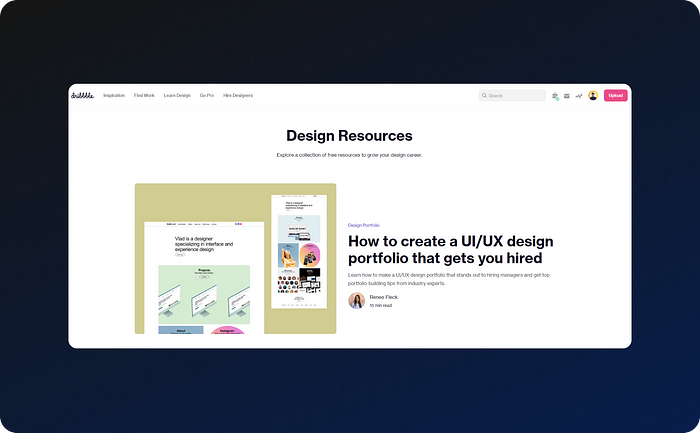
not only have blogs related to UI/UX design but also on typography,
branding, and how to earn as a designer(my personal favourite).
If you are a junior UI/UX designer you must check it out.
Another
great platform like Growth Design. It has a compilation of 58 UX case
studies on different topics ranging from Fintech, Gaming, Social,
Crypto, Desktop, Onboarding and IOS.
The
best part about these UX case studies is they are very well researched
and they not just talk about the UX problem but also the most optimum
solutions to them.
They
also have a good collection of UX glossaries where different UX
Psychologies, Design Principles and concepts are explained in the
simplest of manner.
💡Fun
fact: The author of Build for mars has done UX audits of companies like
Notion, Strip, Quickbooks, Klarna & Epidemic Sound.
Ciphers Lab is a USA-based Digital Product Studio, that provides services like Web App design & development, Mobile Application design & development, UI/UX, Chatbot development, E-commerce development, Designing & Branding, Social Media Marketing, and virtual CTO. For further information.get connected now
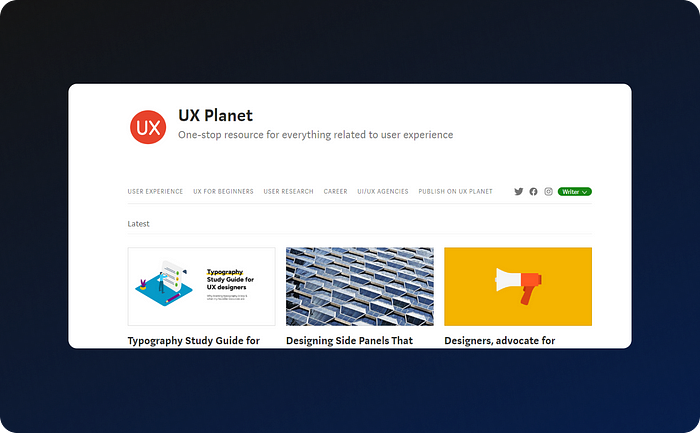
One of my favourite UX publications on medium. Just a quick read daily, will keep you updated with the UX industry.
The best part about this blog is it has new fresh articles every day, so the content always is relevant.
It even has a dedicated category for UX for Beginners, which can be extremely beneficial for junior designers.
I personally try to publish all my articles on UX Planet just because it has such rich content.
Ciphers Lab is a USA-based Digital Product Studio, that provides services like Web App design & development, Mobile Application design & development, UI/UX, Chatbot development, E-commerce development, Designing & Branding, Social Media Marketing, and virtual CTO. For further information.get connected now
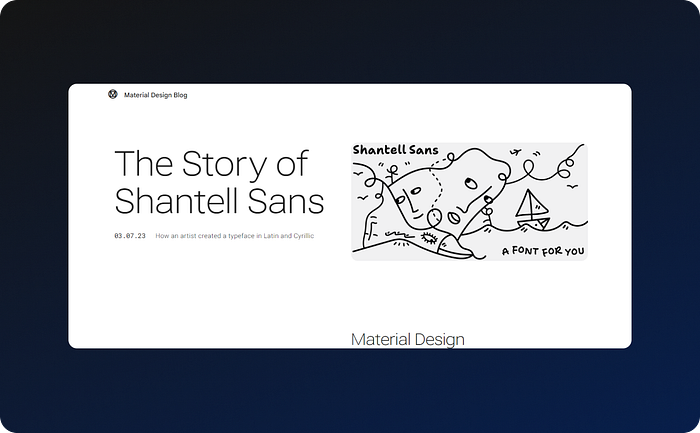
No, this blog does not only talk about Material Design Systems.
It
has some amazing articles on accessibility, designers-focussed articles
on how they solved a particular problem and of course how to use
Material Design Systems in the best possible way.
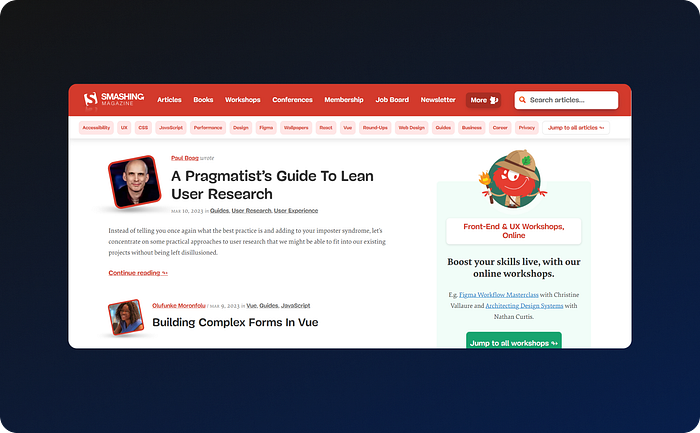
A
blog that not only caters to designers but also front-end developers.
Articles on topics ranging from UX, Design, Figma and web design.
Most articles' lengths are quite long, but they are surely very detailed.
So if you are someone who likes going deep into a topic this is probably a good blog for you.
Ciphers Lab is a USA-based Digital Product Studio, that provides services like Web App design & development, Mobile Application design & development, UI/UX, Chatbot development, E-commerce development, Designing & Branding, Social Media Marketing, and virtual CTO. For further information.get connected now
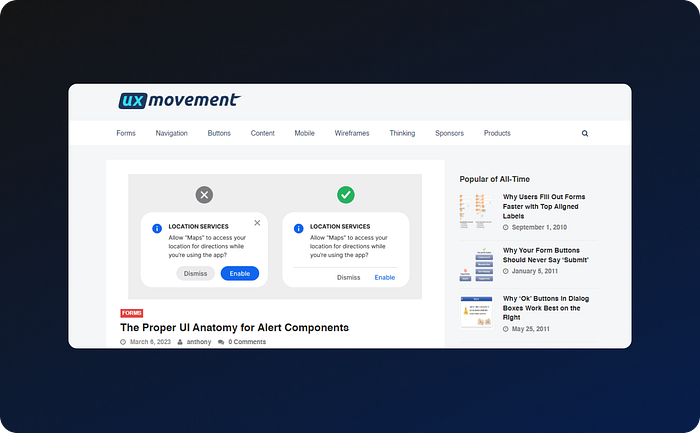
Great
blogs on hands-on UX knowledge such as “How to Optimize Your Sidebar
Menu for High Usability“ and many more such interesting blogs.
If you are interested in learning the practical implications of different UI components this will be a great blog for you.
Ciphers Lab is a USA-based Digital Product Studio, that provides services like Web App design & development, Mobile Application design & development, UI/UX, Chatbot development, E-commerce development, Designing & Branding, Social Media Marketing, and virtual CTO. For further information.get connected now
In
conclusion, becoming a successful UI/UX designer takes more than just
creativity and passion. It requires staying up-to-date with the latest
trends, best practices, and tools in the industry.
So,
bookmark these blogs, subscribe to their newsletters and make it a
point to read them regularly. By doing so, you’ll be on your way to
becoming a UI/UX designer who not only creates beautiful and functional
designs but also understands the user’s needs and delivers exceptional
user experiences.
Ciphers Lab is a USA-based Digital Product Studio, that provides services like Web App design & development, Mobile Application design & development, UI/UX, Chatbot development, E-commerce development, Designing & Branding, Social Media Marketing, and virtual CTO. For further information.get connected now
👋Hey there, If you are interested in more UI/UX-related design topics you can follow me on LinkedIn and Medium.
Also here are some great free UI/UX resources on Gumroad & Figma Community. Do check them out :)
The underlying technology that powers ecommerce stores is evolving
at a dizzying pace, and brands need to respond in real time just to stay
relevant against a backdrop of rising costs. It’s therefore more
important than ever for developers to keep up-to-date on new trends and
skills to be able to offer the best experience to merchants, so that
they can, in turn, offer the best possible customer experience.
We spoke to leading Shopify Partners and Developers to identify seven
key development trends and emerging best practices you need to know to
effectively build for Shopify in 2023. Consider them for your projects,
and you’ll set up your clients—and yourself—for success.
Ciphers Lab is a USA-based Digital Product Studio, that provides services like Web App design & development, Mobile Application design & development, UI/UX, Chatbot development, E-commerce development, Designing & Branding, Social Media Marketing, and virtual CTO. For further information.get connected now
Build apps for Shopify merchants
Whether you want to build apps
for the Shopify App Store, offer custom app development services, or are
looking for ways to grow your user base, the Shopify Partner Program
will set you up for success. Join for free and access educational
resources, developer preview environments, and recurring revenue share
opportunities.
Elster argues that ease of checkout is the last bottleneck to
overcome for mobile conversion rates to exceed desktop conversion rates
and highlights two new feature sets Shopify announced in 2022 that will
change the checkout experience for the better.
For non-Plus merchants, Shopify Functions
will provide backend scripting power similar to Plus plans' Script
Editor. Functions will allow devs to make more efficient and powerful
apps that streamline discount and checkout logic.
“Both options will let Shopify Partner Developers package their
solutions for sale in the Shopify App Store,” Elster explains. “It's a
new blue ocean of monthly recurring revenue waiting to be made.”
Gil Greenberg, founder of Checkout Blocks,
a Shopify Plus app that customizes checkout, agrees. To him, one of the
biggest benefits of the new checkout UI extensions is that it
incorporates the merchant's checkout styles seamlessly without any
additional effort by the app developer.
“Shopify provides a set of UI components that an app can leverage
within checkout which can seem limiting at first but ultimately leads to
faster development and a more consistent customer experience,”
Greenberg says.
In 2023, more merchants will be looking for apps that support the new
checkout and it poses another opportunity for developers to create
value for their clients.
Ciphers Lab is a USA-based Digital Product Studio, that provides services like Web App design & development, Mobile Application design & development, UI/UX, Chatbot development, E-commerce development, Designing & Branding, Social Media Marketing, and virtual CTO. For further information.get connected now
2. Cut down development time by enhancing pre-built themes
Due to increased inflation and the threat of a recession, merchants
are looking for more cost-saving measures in the new year. This means
Shopify developers need to use their resources wisely.
Anne Thomas, co-founder of Shopify app Design Packs, believes that, with the rollout of Online Store 2.0, we are seeing more agencies leveraging add-on components to augment free or paid themes—such as Shopify’s own Dawn theme—rather than developing everything from scratch.
“As a result, code updates can be handled by external theme
developers instead of an internal team, and the technical debt
associated with unmaintained custom builds can be reduced,” Thomas
says.
Together with Shopify's GitHub integration and Shopify CLI
for themes, this approach simplifies code updates, Thomas explains, and
allows easy integration of custom sections created by in-house
developers alongside using libraries of pre-built sections.
3. Engage international audiences with lower costs
As rising interest rates cause retailers across industries to focus
on improving unit economics, David Wagoner, co-founder and CMO of
full-service ecommerce agency P3 Media, expects Shopify Markets and Shopify Markets Pro to become critical tools for brands testing cross-border expansion.
“These tools solve most business process pain points around
internationalization with low or no additional overhead,” Wagoner
explains. “Up to this point, multinational brands have primarily opted
to develop discrete online stores to serve each region in which they
operate, or to go headless.”
Wagoner points out that, while the discrete approach gives brands
granular control over each instance, the cost of doing business under
such a paradigm can be prohibitively high: Each store built this way
requires its own product catalog, pricing, inventory, design,
merchandising, payment options and tax compliance.
The headless solution of coupling a frontend as a service solution to
a single backend, meanwhile, solves content customization issues, but
can be expensive to implement and leaves the merchant responsible for
pricing, payment, tax, and payout issues.
Markets Pro then offers the reverse: payments, taxation, and payouts are all handled automatically.
Wagoner concludes: “With a significantly shorter time to value, no
additional upfront cost to Shopify Plus users, the ability to stand up
MVP shops in over 130 markets overnight, and the promise that Hydrogen
will make Markets headless, these tools are positioned to be extremely
viable alternatives for merchants who want to begin internationalizing
with a low initial investment.”
Ciphers Lab is a USA-based Digital Product Studio, that provides services like Web App design & development, Mobile Application design & development, UI/UX, Chatbot development, E-commerce development, Designing & Branding, Social Media Marketing, and virtual CTO. For further information.get connected now
4. Make the most of metafields
For Ben Wellby, managing director of Shopify specialists Thought and Mortar, one feature stands out among the many recent Shopify development updates: Metafields.
Metafields is a flexible way to extend Shopify’s native functionality
by enabling the storage of additional information about a resource—like
a size guide on a product page, a relevant warranty upsell within the
basket, or some deeper customer information at signup.
Metafields have benefits for customers, developers, and store owners
alike; they improve everyone’s experience of the Shopify ecosystem.
This “extra” information can be accessed on the front-end of the
store, either by developers looking to expose this information through
Liquid logic, or as a customer who may be in need of additional,
supportive information.
“Metafields used to be the stuff of developers, hidden from the store
owner, but have now wholeheartedly been embraced by the Shopify
community,” Wellby says. “Metafields have benefits for customers,
developers, and store owners alike; they improve everyone’s experience
of the Shopify ecosystem.”
Specifically, the team at Thought and Mortar has identified the following trends:
Developers relinquishing control to clients: Clients
are now able to create their own metafields and link them into their own
themes without the need for additional development resources.
Customers looking for more content on PDP pages: More
product-specific information empowers customers to make key decisions at
key moments, thereby increasing engagement with content such as size
guides, warranty info, and product weights with or without packaging. As
a result, customers need less customer service.
Store owners storing more data-points against customer records: Metafields
can be used for both connecting APIs with third-party CRMs, as well as
giving customer service teams immediate access to customer information
at any touchpoint across the Shopify admin (e.g. VAT numbers, preferred
contact methods, customer IDs).
The focus on metafields themselves: Metafields continue
to evolve and already enable developers to create stores that are
native to Shopify, resulting in safer and more sturdy ecommerce
experiences.
Ciphers Lab is a USA-based Digital Product Studio, that provides services like Web App design & development, Mobile Application design & development, UI/UX, Chatbot development, E-commerce development, Designing & Branding, Social Media Marketing, and virtual CTO. For further information.get connected now
5. Take headless commerce to the next level
As the understanding of headless commerce matures, Ian Jamieson, head of technology at Shopify Plus agency Swanky, believes we will see the increased adoption of Hydrogen (Shopify’s React-based framework for building custom storefronts) and Oxygen (Shopify’s hosting platform for Hydrogen storefronts).
Jamieson expects more complete new headless builds, the integration of standalone Hydrogen UI components
within existing headless projects, and more advanced and innovative use
cases beyond enhanced performance and improved developer experience.
Specifically, he sees these opportunities presented by composable architectures:
A shift to unified content platforms such as Sanity.io,
which enables the creation of truly dynamic and regionalized content
experiences while reducing the workload on content creation teams.
Deep integration ofblazing-fast personalization and machine learning recommendation engines, such as those provided by Crossing Minds and Dynamic Yield, to provide a more engaging buying experience and increase retention.
Use of better A/B testing and feature-flagging capabilities, via platforms such LaunchDarkly and Growthbook, which derive and share valuable insights into buying behavior.
Drew Garratt, principal headless developer at Shopify Plus agency We Make Websites, thinks Shopify’s recent acquisition of open-source React framework Remix will push headless commerce even further.
“Remix has been praised for the efficiency and flexibility of its
routing system and use of server components,” Garratt explains.
“Hydrogen on Remix will now unleash the potential of developers to
create even more flexible, complex, and varied experiences—at no
additional cost.”
6. Adopt an objectives-first mentality
Galen King, founder and strategic director of Shopify Plus agency Lucid,
points out that if you’ve worked with a client for some time, you will
have a constantly growing list of feature requests and requirements for
changes to their store. It’s less likely to have a clear picture of
their goals and objectives.
“Unless you have significant experience, discipline, and expertise to
lead clients with firmness and confidence, it’s easy to fall into a
cycle of the client prescribing the solutions,” King cautions. “You will
find yourself simply building what they ask—and usually without a
sufficient budget, timeline, or scope of work to thoroughly explore the
problems they are facing.”
The issue with building features and functionality, however, is that
it’s easy to lose the view of where your client is, where they want to
be, and how you might help them get there.
“If, on the other hand, you can reframe the list of features and
functionality requests to focus on the overarching goals and objectives,
you will find that it becomes much easier to determine what is
important and what is going to have a genuine chance of moving the brand
forward,” King suggests.
This helps you lead your clients better as you will ask better questions, unpack the why and the purpose behind requests, and, ultimately, develop better solutions to the underlying problems.
By reframing the requests, you’ll also find that many client requests
aren’t actually necessary and you and/or your team will spend less time
building things that have little impact and more time designing simpler
solutions to increasingly complex problems that will have real value to
your clients.
As a result, you will be able to iterate more quickly, keep your
clients for longer, and increase profitability for your team and for
your clients. You will find that you quickly become less of a tool in
their toolbox and more of a highly-valued expert resource that is
instrumental in their growth.
Ciphers Lab is a USA-based Digital Product Studio, that provides services like Web App design & development, Mobile Application design & development, UI/UX, Chatbot development, E-commerce development, Designing & Branding, Social Media Marketing, and virtual CTO. For further information.get connected now
7. Participate in the commerce community
Whatever you build on Shopify in 2023, remember that you’re not on
your own. The Shopify Partner and Developer ecosystem offers various
ways for developers to connect.
Steven Clift, CEO of GoodCarts,
a cross-promotion platform specifically built for mission-driven
ecommerce stores, says it’s all about finding peers who are also focused
on building better commerce.
Whatever you build on Shopify in 2023, remember that you’re not on your own.
Ciphers Lab is a USA-based Digital Product Studio, that provides services like Web App design & development, Mobile Application design & development, UI/UX, Chatbot development, E-commerce development, Designing & Branding, Social Media Marketing, and virtual CTO. For further information.get connected now
Development trends that put experience at the heart of your tech stack
The technology landscape is in perpetual motion. For those using
technology on the Shopify platform, the development trends of 2023 will
be all about providing better experiences: a better developer
experience, a better merchant experience, and a better customer
experience.
The development trends of 2023 will be all about providing better experiences.
This article has shown how you can review your tech stack keeping
these experiences in mind. Think carefully about how your development
skills can help reduce expenses for your clients, maximize
cost-effective options, and improve the checkout experience (especially
on mobile devices). More than anything, implement a flexible, efficient
workflow focused on your clients’ goals and objectives.
Over the next 12 months, the tools and technologies that ecommerce
developers have at their disposal will continue to push commerce
forward. To stand out from the crowd, you not only need to be aware of
them, you also need to decide on the tech that is most suitable to the
specific projects you’re working on. Here’s to another exciting year on
the Shopify platform!
Ciphers Lab is a USA-based Digital Product Studio, that provides services like Web App design & development, Mobile Application design & development, UI/UX, Chatbot development, E-commerce development, Designing & Branding, Social Media Marketing, and virtual CTO. For further information.get connected now
When Shopify was started in 2006, it was a novel product with a novel
idea: to provide the best commerce tools in the world to all merchants
of all sizes, to make commerce better for everyone.
A lot has changed since then, but a few things haven't: why we do it
and who we do it for. The price we charge for access to the best tools
in commerce has remained largely unchanged for the last 12 years. Today,
after much deliberation, we're announcing a change in favor of better
serving our mission and our merchants: We are updating our pricing for Basic, Shopify, and Advanced plans: Our pricing page outlines the new prices.
Existing merchants won't see a price change for three months. The
updated pricing is now in effect for new merchants, and they can explore
Shopify and build their businesses for as little as $1 per month during their paid trial. Shopify is still the best value in commerce.
Ciphers Lab is a USA-based Digital Product Studio, that provides services like Web App design & development, Mobile Application design & development, UI/UX, Chatbot development, E-commerce development, Designing & Branding, Social Media Marketing, and virtual CTO. For further information.get connected now
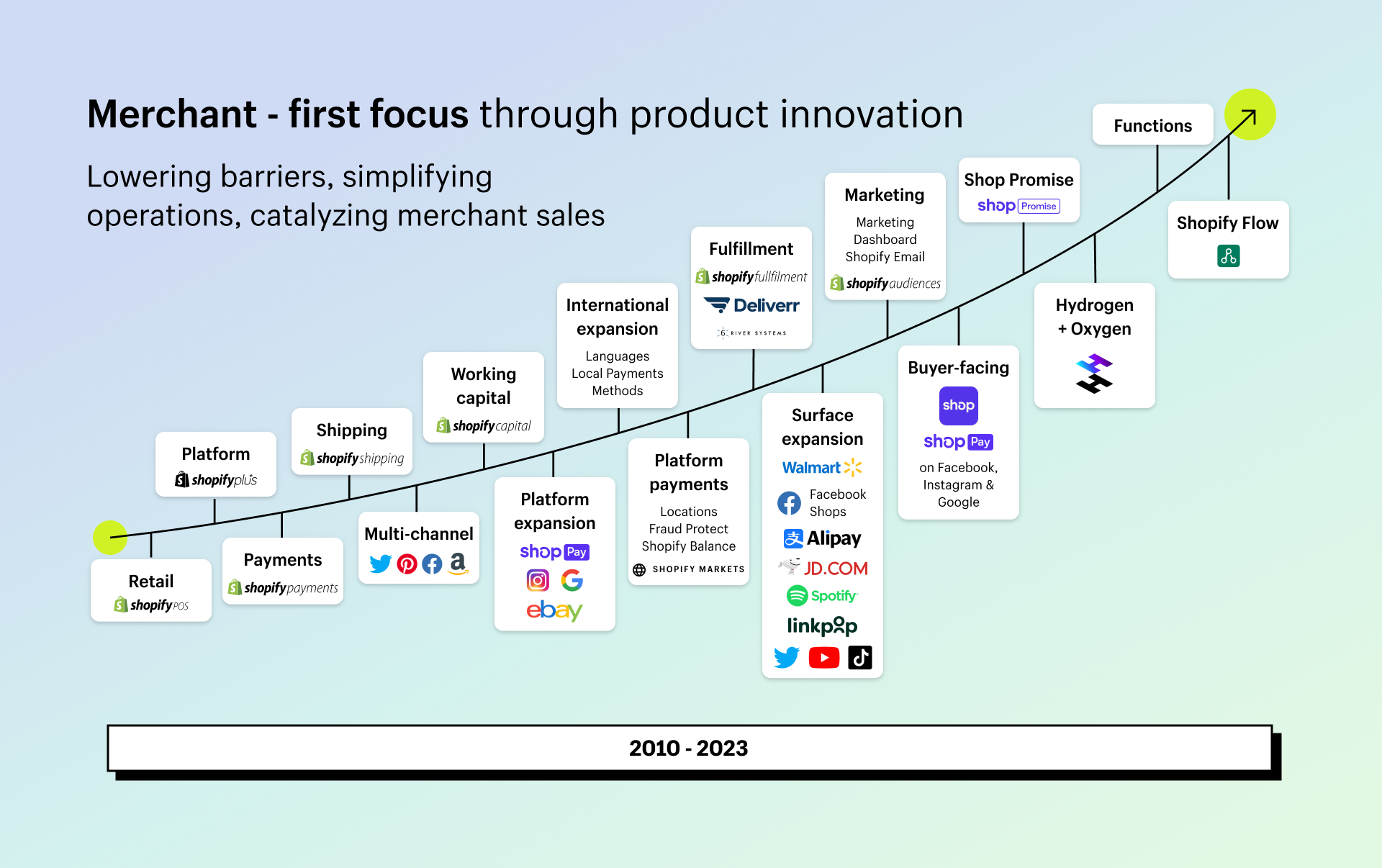
A business built on change
Shopify, and the tools that we build, have always been driven by an
insatiable desire to make more possible tomorrow than is imaginable
today. Our mission is to enable more entrepreneurs and more kinds of
businesses to build and create across all surfaces, all around the
world.
We have continually raised the ceiling so that we outpace the
impossible. And when we raise the ceiling we also raise the floor, so
that merchants joining and using Shopify today have access to tools that
we couldn't have dreamed of existing 16 years ago. We obsess over your
success, and how to increase it by building more into our platform. Your
success is our success.
A small change that enables big change
The idea behind the products we create has always been the same: we
offer merchants the most powerful, innovative, and reliable tools in the
industry at a price that's unmatched in the market. But what that
means, and the resources required to live up to that promise, have
changed dramatically since we started.
In order to not change the value of Shopify, we’ve had to change the price.
This change allows us to continue to solve some of the most difficult
problems in the industry with the people that are best suited to solve
them. It allows us to continue making more possible and empower more
people to become entrepreneurs, and to do it at a pace that's necessary
to make commerce better for everyone.
Above all else, it means that we don’t have to compromise. It allows
our merchants to continue to exist in a world where their dreams for
what their businesses can become never have to contend with what is
possible.
We thank you for your support, now and always, in allowing us to continue doing what we do best for many more decades to come.
We’ll keep making Shopify the best
platform to sell things anywhere your customer is and we’ll keep
creating a culture of innovators and builders pushing forward the
frontier of commerce. We’re not slowing down.
Visit your plan page to select yearly billing or make changes.
Kaz Nejatian is Shopify’s VP of Product and Chief Operating
Officer. Kaz oversees a cross-functional team that develops and delivers
tools for entrepreneurs to supercharge their growth on Shopify. These
products give independent merchants access to commerce innovations that
have historically only been available to big businesses.
Ciphers Lab is a USA-based Digital Product Studio, that provides services like Web App design & development, Mobile Application design & development, UI/UX, Chatbot development, E-commerce development, Designing & Branding, Social Media Marketing, and virtual CTO. For further information.get connected now